
How to Compare Two Roofing Bids That Sound Similar but Aren't

I sat down with a building owner in Atlanta last month. He had three bids on his desk for a 20,000-square-foot TPO replacement. They all looked professional. They all had nice letterhead. They all listed a price per square foot.
The bids were $112,000, $134,000, and $158,000.
He said, "The middle one seems reasonable. The high one is too much. The low one makes me nervous. What do you think?"
I asked him, "Can I see the scopes?"
He handed them over. I spent about 15 minutes reading them side by side. Then I pointed out that the "low" bid was actually the most expensive, and the "high" bid was probably the best value.
He looked at me like I'd just told him the earth was flat.
Here's what I saw: the low bid didn't include a cover board. The middle bid included one, but used a thinner gauge metal for edge flashing. The high bid included a thicker membrane, a full cover board, and a five-year labor warranty. The low bid had a ten-year manufacturer warranty but no labor warranty from the contractor. The high bid had a twenty-year manufacturer warranty and the contractor's labor warranty on top.
On paper, the low bid was $112,000. But to get what the high bid offered, the owner would have had to add about $12,000 for a cover board, $8,000 for upgraded edge metal, and he'd still have no labor warranty. By the time he got apples to apples, the low bid was actually $150,000 — and still missing the warranty.
So the "$158,000" bid was actually only $8,000 more than the "low" bid, for a vastly better roof. And the "low" bid was the one that would have cost him more in the long run.
Why Bids Look Similar When They're Not
There's a reason this happens all the time. Roofing proposals are written in a language that's half technical, half vague. They use terms like "industry standard," "standard details," and "as required" — phrases that sound meaningful but mean almost nothing.
One contractor's "standard" is another contractor's "bare minimum." And neither of them is wrong, technically. They're just using words that let you fill in the blanks with your own assumptions.
The problem is, your assumptions are probably wrong. You assume "standard" means "good enough." But in roofing, "standard" often means "the cheapest thing that won't get me sued."
The Three Bids Trap
Most owners get three bids and pick the middle one. It's human nature. The low one feels risky, the high one feels like you're being taken advantage of, and the middle one feels like the Goldilocks solution.
But the middle bid isn't inherently better. It's just a number that happens to sit between two others. It tells you nothing about the quality of the materials, the skill of the crew, or the completeness of the scope.
I've seen "middle" bids that were missing insulation. I've seen "middle" bids that used 45-mil TPO when 60-mil was clearly needed. I've seen "middle" bids that had no allowance for deck repairs — meaning the owner would be hit with a huge change order the moment the old roof came off.
The middle bid is not a safe choice. It's just a choice.
The Line-Item Method

Here's the approach I use with owners. It's not complicated, but it takes a little patience.
Step 1: Get each bid in electronic format.
You need to be able to copy and paste sections. If a contractor won't send you a digital copy, that's a red flag. They're either hiding something or they're not comfortable with transparency.
Step 2: Create a comparison spreadsheet.
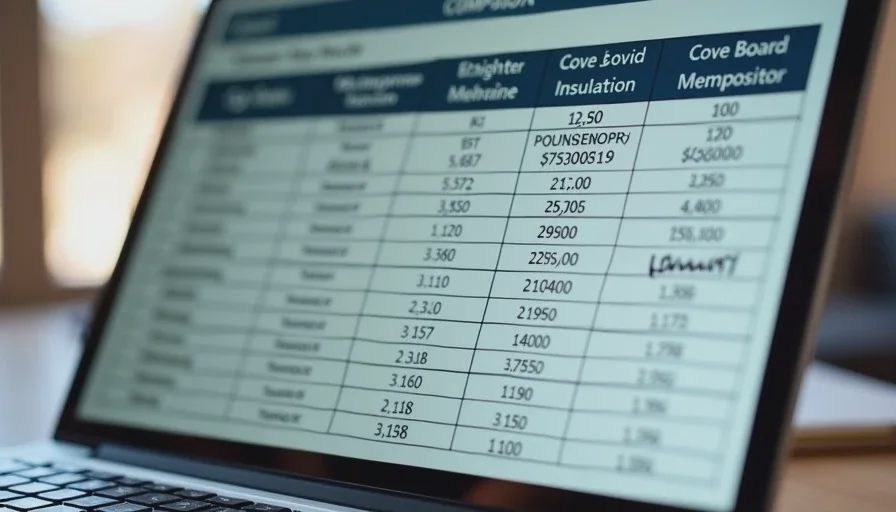
List every major scope item down the left side: membrane type and thickness, insulation type and thickness, cover board, edge metal (material and gauge), flashings, drain work, tear-off vs recover, deck repair allowance, warranty (material and labor), clean-up and disposal. Leave room for notes.
Step 3: Fill in what each bid actually says for each item.
Don't interpret. Don't guess. If the bid says "standard insulation," write that. If it says "16-gauge metal" on one and "aluminum" on another, write exactly that. If it doesn't mention deck repairs at all, write "not specified."
Step 4: Compare the missing items.
The bids that are most complete are the ones where you don't have to guess. The bids where you have to fill in blanks are the ones that will come back to bite you later.
Step 5: Ask each contractor to fill in any blanks.
Say, "Your bid doesn't specify the insulation thickness. Can you add that?" Or, "Can you clarify your deck repair allowance?" A good contractor will answer promptly. A bad contractor will get defensive.
The Things That Get Hidden (Or Just Not Mentioned)
I've seen this enough times to know where the common omissions live.
Cover board. This is a layer of gypsum or wood fiber board that sits between the insulation and the membrane. It protects the insulation from foot traffic, provides a smooth substrate, and increases puncture resistance. It's not required by code in many places, but it's a huge upgrade. Contractors who omit it can underbid by $1-2 per square foot.
Insulation taper. If your roof doesn't drain well, you need tapered insulation to create slope. But tapered insulation costs more than flat insulation. Some contractors just don't include it, assuming you won't notice until after the roof is done and water is still ponding.
Edge metal gauge. Thicker metal costs more. A contractor who quotes thin gauge metal (like .032" aluminum) can underbid someone who quotes .040" or .050". The thinner metal will corrode and fail sooner, but you won't know that for a few years.
Flashing details. Some contractors include all new flashings at every penetration. Others "re-use existing" or "flash as required." What does "as required" mean? It means whatever the crew decides in the moment. That's not a plan.
Deck repair allowance. This is the big one. When the old roof comes off, someone has to fix the deck underneath. Some contractors include an allowance — say, $5,000 for repairs. Others put "deck repairs at owner's expense" in the fine print. That's a blank check.
Labor warranty. The manufacturer's warranty covers the material. But if the material fails because the installation was bad, you're covered only if the contractor has a labor warranty. Some contractors don't offer one. Some offer one year. The best offer five years or more. If a bid doesn't include a labor warranty, you're on your own if the workmanship fails.
The Real Cost of Choosing the Wrong Bid
I worked with a church in Missouri a few years ago. They had a 15,000-square-foot flat roof that needed replacement. They got three bids and chose the cheapest one — by about $20,000. The contractor seemed nice enough. The materials were a name brand. Everything looked legitimate.
The roof was installed in June. By October, it was leaking. They called the contractor. The contractor came out, patched it, and said it was fine. Leaked again in November. Another patch. Leaked again in January.
Finally, they called me. I walked the roof and found the problem: the seams on the TPO had been welded at too low a temperature. The welds looked good from the outside but had no structural bond. Water was getting under the seams and traveling horizontally for 20 feet before finding a way down.
The contractor's labor warranty? Six months. And they had already missed a few scheduled inspections. So the church had no recourse. They ended up hiring a different contractor to re-weld almost every seam — a $30,000 repair on a roof that was only 18 months old.
That $20,000 "savings" cost them $30,000 and two years of leaks. The middle bid would have been a better roof and a better warranty.
The Questions That Cut Through the Fluff
When you're comparing bids, here are some questions to ask each contractor. The answers will tell you a lot.
"What specific insulation are you using? Manufacturer, type, R-value, and thickness?"
If they can't answer this off the top of their head, they haven't thought it through. A good contractor knows exactly what they're using.
"Are you including a cover board? If not, why?"
The only valid reason to skip a cover board is a really tight budget. There's no technical reason to skip it.
"What's your deck repair allowance? What happens if the damage exceeds that?"
Look for a specific number and a clear process. "We'll fix what's needed and bill you" is not a clear process.
"What is your labor warranty? What does it cover?"
If it's under two years, that's a yellow flag. If it's not explicitly a labor warranty (some contractors say "warranty" but mean the manufacturer's warranty), that's a red flag.
"Can I see a sample of your transition detail?"
If they can't show you how they handle the edge of your roof — where the new roof meets the old or meets the wall — they haven't really planned the project.
"What is your schedule for this project? What's the weather contingency?"
A vague schedule is a sign they haven't thought through logistics. That's where delays and cost overruns come from.
The One Number That Matters Most
Everyone focuses on the total price. But the number you really need to look at is the cost per year of expected service life.
Here's a simple example:
Bid A: $100,000, expected life 15 years, cost per year $6,667.
Bid B: $120,000, expected life 20 years, cost per year $6,000.
Bid B is cheaper over time, even though it's $20,000 more upfront.
This is the calculation that owners almost never do. They look at the upfront number and compare that. But roofs are long-term assets. The cheapest bid often has the lowest upfront price and the highest annual cost.
Frequently Asked Questions
1. Why do bids vary so much on the same roof?
Because contractors make different assumptions. One assumes you want the cheapest possible roof. Another assumes you want a durable, long-lasting system. And some contractors just need the work and bid low to get it.
2. Should I always take the lowest bid?
Almost never. If a bid is more than 15% lower than the others, there's something missing — materials, labor, warranty, or some hidden cost that will come up later. You don't need to pick the highest either, but avoid the outlier on the bottom.
3. What's the most important line item to compare?
Insulation and cover board. These are the biggest differentiators in bid completeness. If one bid includes a cover board and the other doesn't, that alone changes the comparison. And you want the cover board — it's worth the extra cost.
4. How can I compare bids without being an expert?
Use the spreadsheet method. Lay them side-by-side and look for the blanks and the vague phrases. Then call each contractor and ask them to fill in the details. The ones that are transparent and responsive are the ones you should trust.
5. What's a "fair" deck repair allowance?
Usually 5-10% of the total project cost. If your roof is in good shape, repairs will likely be under that. If you're in an older building or the roof has been leaking for years, expect more.
6. What's the difference between a material warranty and a labor warranty?
A material warranty covers defects in the product itself (the TPO, insulation, etc.). A labor warranty covers installation mistakes. You need both. A material warranty is useless if the contractor didn't install it right and won't fix it.
7. How long should my labor warranty be?
Minimum 2 years. Ideally 5 years. In some markets, 10-year labor warranties are available for premium installers who are certified by the manufacturer. That's a strong signal.
8. Should I include a penalty clause in my contract if the project is delayed?
Yes. But be realistic. Weather delays and unforeseen deck issues happen. I usually recommend a 10% penalty for delays beyond 14 days unless caused by weather or owner-requested changes. Get legal advice before putting this in a contract.
Owner Letters
0 lettersNo letters yet — be the first to write one.