
Sectional Couches: A Practical Guide to Choosing the Right Layout

Sectional couches can transform an open living room, office lounge, media space, or family room when the size and configuration match the way people actually use the room. They can provide more seating than a standard sofa, define an open floor plan, and create a comfortable place for conversation or movie nights. They can also become an expensive mistake if the frame will not fit through the doorway, the chaise blocks a walkway, or the fabric cannot handle daily use. The decision is not just about appearance. It is about measurements, traffic patterns, construction, cleaning, and timing.
Start With the Room, Not the Showroom
Before comparing colors, measure the room’s usable space. Record the length of each wall, the location of windows, outlets, radiators, doors, vents, and built-in cabinets. Then measure the entrance path from the street or loading area to the final room. A couch that fits one wall may still fail at a narrow hallway, stair landing, elevator, or sharp corner.
Use painter’s tape on the floor to outline the proposed footprint. Leave roughly 30 to 36 inches for a comfortable main walkway, and avoid covering heating vents or blocking doors. In a smaller apartment, a 90-inch chaise design might be more practical than a sprawling U-shaped arrangement. In a large basement, a modular design with five or six seats can fill the room without looking undersized.
Pay attention to depth, too. Many sectional couches measure 35 to 40 inches deep, while extra-deep models can exceed 45 inches. That deeper seat feels relaxed, but it can make a narrow room feel crowded. If family members have different heights, test whether feet can rest comfortably on the floor rather than assuming a soft showroom cushion will work for everyone.
Choose the Configuration That Matches Daily Use
A left-facing or right-facing chaise is a simple choice, but the labels can be confusing. They usually describe the direction as you face the couch, not as you sit on it. Ask the retailer to confirm the orientation with a diagram, especially when the chaise is fixed. A reversible chaise gives you more flexibility after a move or furniture rearrangement.
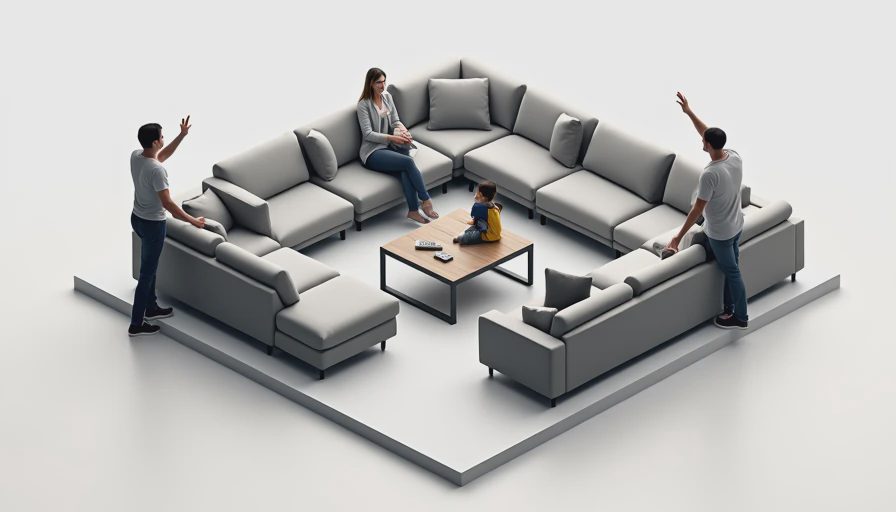
L-shaped sectional couches work well against two walls or as a divider between a living area and dining space. U-shaped designs encourage group conversation and offer generous seating, but they require a wide room and careful delivery planning. Curved configurations look distinctive and soften a large space, although they often need more clearance from walls and may have fewer replacement options.
Modular pieces offer a different kind of control. A three-piece arrangement can become a four-piece layout later, provided the collection is still available. That flexibility is useful for renters, growing families, and homeowners who expect to move. However, connectors should be sturdy, and the individual pieces should not separate whenever someone sits down or stands up.
Inspect the Frame, Cushions, and Upholstery
A low price does not automatically mean poor construction, and a recognizable brand does not guarantee that every model is built for heavy use. Ask what material is used in the frame, how the joints are reinforced, and whether the legs are attached to the frame or simply screwed into a thin base. Kiln-dried hardwood frames are commonly valued for stability, while engineered wood can perform well when the design and joinery are sound.
Sit in the exact spot where you expect to sit at home. Listen for creaking, feel whether the seat bottoms out, and check whether the back support keeps you upright. Foam density, coil construction, and cushion thickness affect how quickly a seat develops a permanent dip. Loose back cushions are easier to fluff and replace, while attached cushions generally stay neater but can be harder to repair.
For busy homes, performance fabric, tightly woven polyester, microfiber, or treated blends are often easier to live with than delicate linen or velvet. Leather can be durable and easier to wipe clean, but it can scratch, show temperature changes, and cost substantially more. Request the care instructions before paying a deposit. “Stain resistant” does not mean stain proof, and aggressive cleaning can damage a protective finish.
Compare Cost Beyond the Sticker Price
Sectional couches can range from about $700 for a basic apartment-size model to $5,000 or more for premium leather, custom upholstery, or high-end modular systems. The purchase price is only one part of the budget. Add delivery, assembly, old-furniture removal, fabric protection, taxes, and possible storage charges if the room is not ready.
A $1,200 model with free delivery may be a better value than a $950 model that adds $250 for stairs and assembly. Conversely, a $3,500 couch is not automatically the right choice if its replacement cushions cost hundreds of dollars or the manufacturer offers limited service support. Ask about the warranty in practical terms: what covers the frame, what covers cushions, and whether labor or transportation is excluded.
When comparing sectional couches, write down the complete delivered price, expected lead time, return rules, and restocking fee. Custom upholstery often cannot be returned, while quick-ship merchandise may have fewer fabric choices. Keep the sales order, fabric name, configuration diagram, and photographs until the item arrives and is inspected.
Plan Delivery Before You Place the Order
Delivery problems are common because buyers measure the room but not the route. Measure the door opening, remove the door from its hinges if necessary, and check ceiling height on stairways. Note tight turns, handrails, low beams, and elevator dimensions. Ask whether the delivery crew brings the pieces in boxes or assembled, and whether they will carry the furniture upstairs.
Protect floors before delivery day. Use moving blankets or floor runners, clear toys and small tables, and keep pets in another room. Inspect every carton for punctures before signing. After unpacking, check seams, legs, reclining mechanisms, connectors, and upholstery under bright light. Photograph damage immediately and report it using the retailer’s stated process.
This step matters with large sectional couches because damage can be difficult to exchange once the full arrangement is assembled. Do not discard packaging until you have completed the inspection and confirmed that the furniture is comfortable, stable, and correctly configured.
Make the Final Choice With a Short Checklist
A good purchase should answer several plain questions. Does the footprint leave a clear path through the room? Can every household member sit comfortably? Is the chaise on the correct side? Can the fabric handle spills, pets, children, or commercial-level use? Are cushions replaceable? Does the frame warranty cover the part most likely to fail? Is the delivery route confirmed?
If the answer to one question is uncertain, pause before ordering. A fabric swatch sent by mail is useful, but it is not a substitute for sitting on the cushion. Visit a showroom when possible, then compare the model against online pricing and current delivery terms. Retailers such as IKEA, Ashley, West Elm, Room & Board, and local furniture stores serve different budgets and construction expectations, so compare the actual specification rather than relying on brand reputation alone.
The best sectional couches are not necessarily the largest or most fashionable. They are the ones that fit the room, survive the intended workload, and remain comfortable after the showroom excitement fades. Measure first, inspect the details, price the complete purchase, and plan delivery before committing. The room does not care about the sales pitch; it reveals whether the layout works every day.
Keep Reading

Upholstery Cleaner: A Practical Guide for Commercial Facilities
Upholstery cleaner guidance for commercial facilities: compare formulas, protect...

Where to Buy Furniture: A Practical Guide for Commercial Property Buyers
Where to buy furniture for a commercial office, waiting room, or break area: com...

Palm Tree Types: A Practical Guide for Property Owners
Palm tree types explained for property owners: learn how species, roots, fronds,...
Owner Letters
0 lettersNo letters yet — be the first to write one.