
Commercial Roof Repair vs Replacement: A Practical Decision Framework
If you manage a commercial building with a flat roof, you will eventually face this question – and it’s one of the most expensive decisions you’ll make on that asset.
Do I repair this roof, or do I replace it?
Contractors will give you answers, but they rarely give you a framework you can apply yourself. One guy says a coating will buy you 10 more years. Another says you need a full tear-off starting tomorrow. Both can’t be right – but both might be acting in good faith, based on what they see.
The problem is, they’re seeing different parts of the same elephant.
What you need is a repeatable, owner-side decision process – one that doesn’t rely on who showed up first or who has the shiniest brochure. Here’s that framework. I’ve used it on hundreds of roofs. It’s not complicated, but it forces you to look at the actual evidence, not the sales narrative.
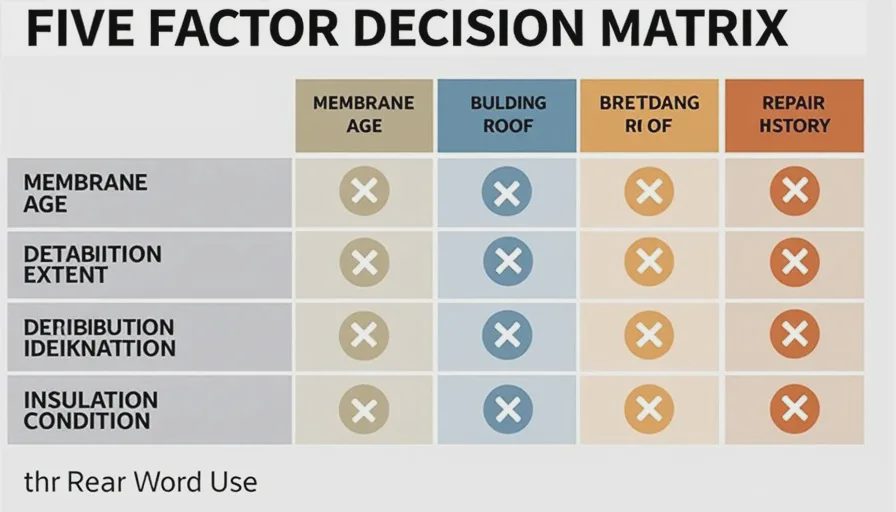
The 5-Factor Decision Matrix
Score each factor honestly. There’s no perfect math, but this will quickly show you whether you’re in repair territory, replacement territory, or the gray middle where a recover or coating might be the smart play.
Factor 1: Membrane Age
This is the starting point because age correlates strongly with failure probability – not because age alone kills a roof, but because older membranes have accumulated thermal cycles, UV exposure, and foot-traffic wear.
Membrane Type | Typical Design Life | When Repair Still Makes Sense | When Replacement Is Likely |
|---|---|---|---|
TPO | 15–20 years | 0–12 years | 15+ years (especially if seams are splitting) |
EPDM | 20–25 years | 0–15 years | 18+ years (check for shrinkage and seam adhesion) |
PVC | 20+ years | 0–14 years | 16+ years (plasticizer loss makes it brittle) |
Modified Bitumen | 15–20 years | 0–10 years | 15+ years (alligatoring and loss of granule embedment) |
Built-Up Roof (BUR) | 20–30 years | 0–18 years | 22+ years (if multiple felts are splitting or blistering) |
Owner’s takeaway:
If your roof is less than halfway through its expected life, repairs are almost always the better financial choice – provided the damage is localized. If it’s past 80% of its expected life, replacement is usually inevitable; you’re just delaying the cost, and often at higher total expense.
Factor 2: Extent of Membrane Deterioration
This is where you need to get on the roof (or send someone with a camera and a checklist). Look for these widespread conditions – not isolated issues:
Condition | Repair-Friendly | Replacement Indicator |
|---|---|---|
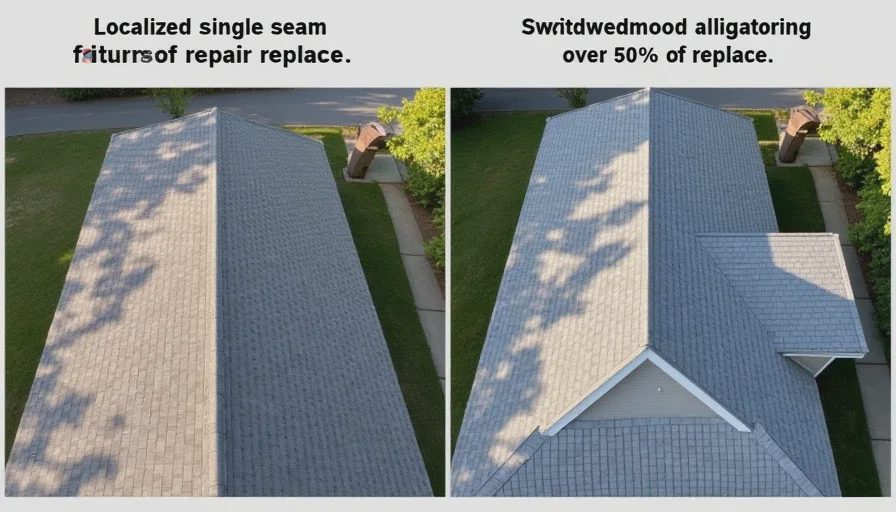
Surface cracking / alligatoring | Only if it’s superficial and small-area | Covers >25% of the roof area |
Seam failure | If < 5 seams are open and rest are sound | If multiple seams are failing across different zones – indicates systemic adhesive failure |
Blistering | Isolated blisters that can be cut out and patched | Blisters > 2 sq ft covering >10% of the roof – suggests trapped moisture or poor adhesion |
Ponding water | If drainage can be corrected with tapered insulation or drain repair | If ponding persists after fixes and membrane has degraded from UV exposure in ponded areas – often leads to algae and accelerated aging |
Owner’s takeaway:
If deterioration is localized (e.g., around one HVAC curb, one failed seam, one drain), repair is almost always the smarter call. If it’s diffuse – meaning the membrane is tired everywhere – you’re treating symptoms, not causes. Replacement is the only way to reset the clock.
Factor 3: Insulation Condition
This is the hidden variable that changes the cost equation dramatically.
Insulation State | What It Means | Decision Impact |
|---|---|---|
Dry, intact, R-value still good | No moisture intrusion; insulation is performing as designed | Repair or recover – you can leave the insulation in place and simply replace the membrane or add a cover board |
Localized wet area (< 15% of roof) | Moisture can be cut out and replaced, then membrane repaired over that area | Repair with insulation replacement – more expensive than simple patching but still far less than full tear-off |
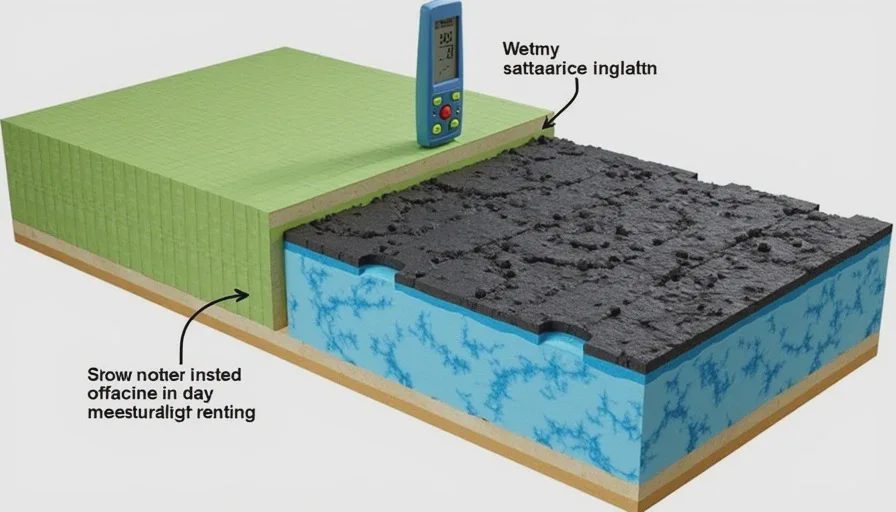
Widespread saturation (> 25% of roof) | Insulation has lost R-value, added weight, and is likely corroding fasteners | Full replacement – because you have to remove the wet insulation anyway; the labor to remove and re-install new insulation is a major part of tear-off cost |
Owner’s takeaway:
Never assume the insulation is fine just because the ceiling isn’t leaking. Get a moisture scan – either nuclear or infrared – as part of any serious evaluation. If more than a quarter of your insulation is wet, a repair doesn’t fix the problem; it just covers it up, and your energy bills will keep rising.
Factor 4: Repair History
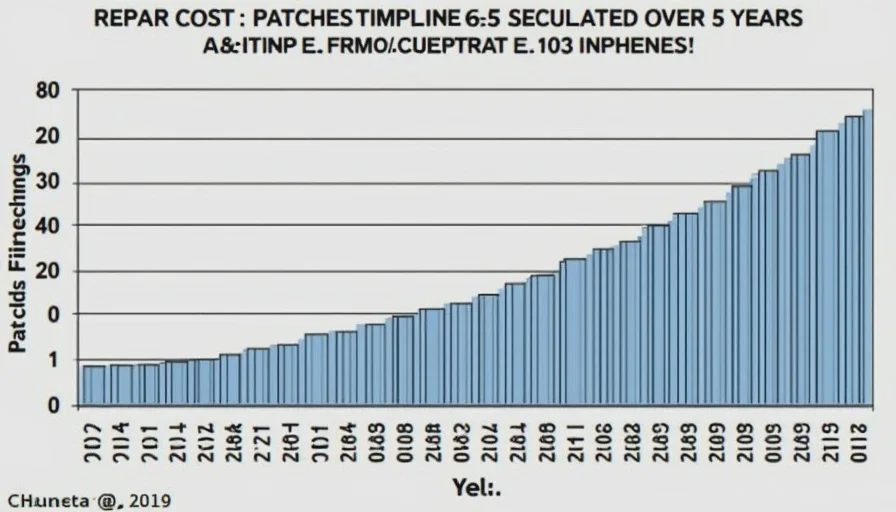
How many times has this roof been patched in the last 5 years? This is a strong behavioral signal.
Repair Frequency | Interpretation |
|---|---|
0–2 repairs in 5 years | Normal maintenance; repairs are still cost-effective |
3–5 repairs in 5 years | You’re chasing problems; each new leak indicates the membrane is losing integrity |
6+ repairs in 5 years | The roof has become a maintenance sink; you’ve likely paid 30–50% of a replacement cost already – and you still have an old roof |
Owner’s takeaway:
Keep a simple log – date of each repair, cost, and whether it solved the problem permanently. When you see a pattern of repeat calls to the same area or increasing frequency across the roof, that’s the market telling you to replace. A patch is not a plan.
Factor 5: Future Building Use and Tenant Sensitivity
This is the “business interruption” factor – and it’s often overlooked in purely technical assessments.
Scenario | Repair or Replacement? |
|---|---|
Building is occupied 24/7, and any roof work would disrupt operations | Schedule a strategic replacement during a planned shutdown or off-season. Don’t do piecemeal repairs that might fail during critical business periods. |
Tenant leases are short-term or the building might be sold in 3–5 years | Repair – you don’t need a 20-year roof if you’re not holding the asset for 20 years. But be honest: a new roof adds resale value; a patch job may scare buyers. |
High-value equipment or inventory under the roof | Replace proactively – the cost of a leak damaging sensitive machinery or merchandise can far exceed the roof replacement cost. |
Owner’s takeaway:
The best technical solution isn’t always the right business solution. Factor in tenant disruptions, lease cycles, and the criticality of the space. Sometimes a more expensive replacement is actually cheaper than the risk of a leak during peak season.
The Decision Matrix in Practice: Three Scenarios
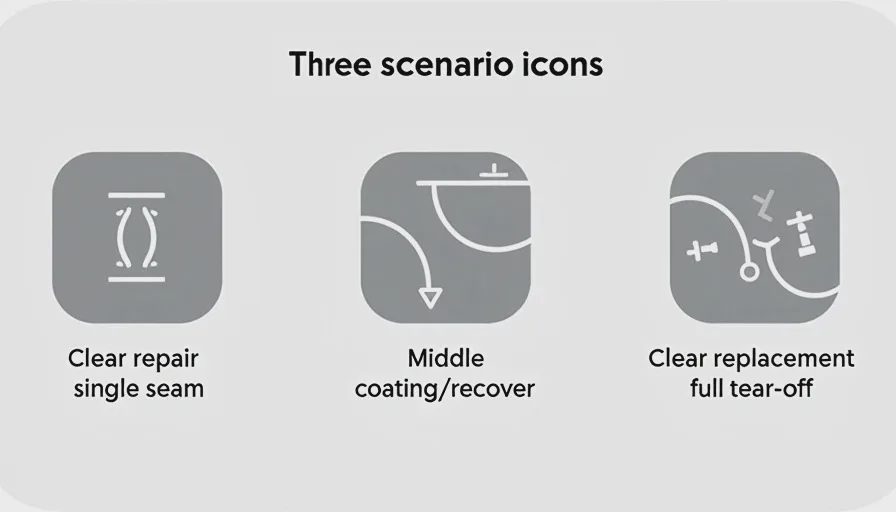
Scenario A: The Clear Repair Candidate
Age: 8-year-old TPO
Deterioration: One failed seam near a drain, no other visible issues
Insulation: Dry (verified by moisture scan)
Repair history: First repair ever
Business: Standard office hours, no sensitive equipment
Verdict: Repair. This is a no-brainer. Cost: $1,500–$3,000. Done.
Scenario B: The Gray Middle – Consider a Coating or Recover
Age: 14-year-old EPDM, still some life but showing surface weathering
Deterioration: Widespread granule loss and minor surface cracking, but no seam failures yet
Insulation: Dry except for 10% localized wet area (which can be cut out)
Repair history: Two patches in last 3 years
Business: Multi-tenant retail, minimal disruption tolerance
Verdict: Recover or coat. A fluid-applied coating or a new single-ply membrane over the existing insulation (with wet areas removed) can give you 10–15 more years at 40–50% of the cost of a full tear-off. This is where the value is.
Scenario C: The Clear Replacement Candidate
Age: 22-year-old modified bitumen
Deterioration: Alligatoring over 60% of roof, multiple seam splits, ponding water in 8 locations
Insulation: Saturated over 35% of the area (moisture scan confirmed)
Repair history: 9 repairs in last 4 years – total cost > $18,000
Business: Critical data center, cannot risk any leaks
Verdict: Full tear-off and replacement. The cumulative evidence is overwhelming. Any repair at this point would be throwing good money after bad. Budget for a new system – and get it done before the next storm season.
The Two Biggest Mistakes Owners Make
Mistake #1: Repairing When You Should Replace
You fix one leak, then another appears next month. You spend $5,000 this year, $6,000 next year, and after 4 years you’ve spent $25,000 – still have an old roof, and now replacement costs have gone up 15% due to material inflation.
Mistake #2: Replacing When You Could Have Repaired
A contractor convinces you that a full tear-off is the “only way to guarantee” – but your roof was only 10 years old with one localized issue. You spend $60,000 that you didn’t need to, and the ROI never materializes.
The smart owner avoids both by using this framework – and by getting multiple, independent opinions.
Your Next Step: Turn Your Diagnosis into Competitive Quotes
Once you’ve worked through this framework, you’ll have a strong hypothesis about whether you need a repair, a coating, a recover, or a replacement. But a hypothesis isn’t a contract. You need real-world proposals from contractors who will actually step on your roof, measure it, and give you numbers.
That’s where SelectHomeQuote fits in.
SelectHomeQuote is a free, no-obligation service that connects you with pre-screened commercial roofing contractors in your ZIP code. You get:
3–4 detailed quotes that include scope of work, materials, timeline, and warranty
Contractors who understand the repair-vs-replace nuance – they’re not just pushy salespeople
A streamlined comparison process that saves you weeks of cold-calling
We partner with SelectHomeQuote because they respect the owner’s need for clarity and choice – not high-pressure closing tactics.
Start your quote comparison today:
➡ Enter your ZIP code on SelectHomeQuote and receive free, customized commercial roof proposals from local professionals who can help you execute the right decision – whether it’s repair, recover, or replacement.
Keep Reading

Home Additions: How to Protect the Existing Commercial Roof
Home additions can create new roof leak paths. Learn how to plan tie-ins, draina...

$200 Window Attic Renovation: What That Budget Really Covers
$200 window attic renovation is rarely a complete fix. Learn what that budget ca...
Can a Roof Coating Extend Life – or Are You Coating Over a Deeper Problem?
Owner Letters
0 lettersNo letters yet — be the first to write one.