
Ponding Water After Rain: When to Monitor and When to Escalate
You walk your commercial flat roof after a heavy rain. There's water sitting in a few low spots. It's been 24 hours since the storm passed, and some puddles are still there.
Do you panic? Do you ignore it? Do you call a contractor immediately?
The answer depends on three things: how long the water stays, how deep it is, and what kind of roof membrane you have. Not all ponding is a crisis – but some ponding is a slow-motion disaster that will cost you dearly if you wait too long.
Here's a practical field guide to reading ponding water, knowing the warning thresholds, and deciding exactly when to escalate from "monitor" to "repair" to "replace."
The 48-Hour Rule – But Don't Take It Literally
Most roofing warranties state that water should not remain on a roof for more than 48 hours after a rain event. That's a contractual line, not a physical one. In reality, damage begins long before 48 hours – especially if the ponding recurs week after week.
Here's the truth:
Ponding that drains within 24 hours: Generally acceptable, especially for EPDM and PVC. Monitor but don't worry.
Ponding that persists 24–48 hours: Yellow flag. Schedule a drainage evaluation within the next 3–6 months.
Ponding that persists >48 hours: Red flag. This is violating warranty terms and accelerating membrane degradation. Escalate within 30 days.
Ponding that never fully dries (standing water between storms): Critical. You have a drainage failure and active deterioration. Escalate immediately.
Owner's takeaway: The clock starts ticking the moment the rain stops – not when you get around to checking. Mark your calendar after every significant storm and note the dry‑out time.
The Depth Factor – Not All Puddles Are Equal
Shallow, thin sheets of water (¼ inch or less) are less damaging than deep pools (1 inch or more). Why? Deeper water holds more weight, stays cooler (slower evaporation), and exerts hydrostatic pressure on seams and flashings.
Depth | Risk Level | Action |
|---|---|---|
< ¼ inch | Low | Monitor; note location for future maintenance planning |
¼ – ½ inch | Moderate | Consider drain cleaning or minor tapered insulation at next re‑cover |
½ – 1 inch | High | Plan for drainage correction within 1 year; start budgeting |
> 1 inch | Critical | Structural concern – weight stress on deck; immediate evaluation needed |
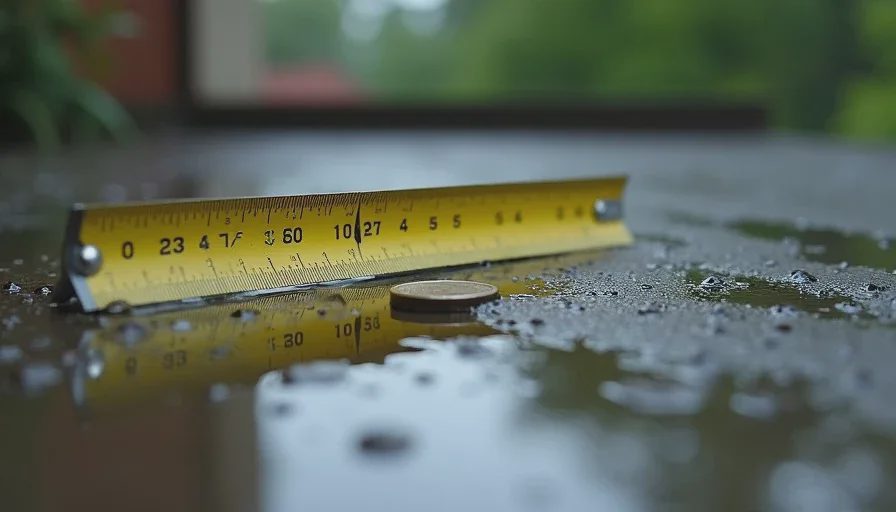
Owner's takeaway: Take a ruler or a marked stick onto the roof after a rain. Measure the deepest point and note it. Photograph it with a recognizable reference (a coin or a tape measure). This creates a baseline for tracking whether ponding worsens over time.
Membrane-Specific Tolerance to Ponding
Not all roofing systems handle standing water the same way. This is one of the most overlooked factors in repair‑vs‑replace decisions.
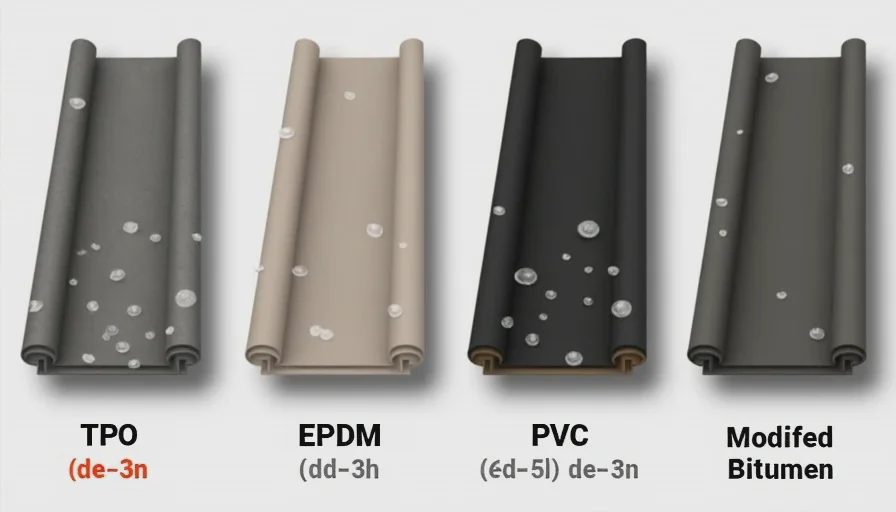
Membrane Type | Ponding Tolerance | Why |
|---|---|---|
EPDM | Good – EPDM is highly water‑resistant; it does not absorb water and is flexible enough to accommodate minor ponding without cracking. | Rubber chemistry resists hydrolysis and biological attack from stagnant water. |
PVC | Excellent – PVC is inherently waterproof and resistant to algae and fungi; ponding causes minimal degradation unless combined with chemical contamination. | Plasticized PVC maintains integrity even in prolonged wet conditions. |
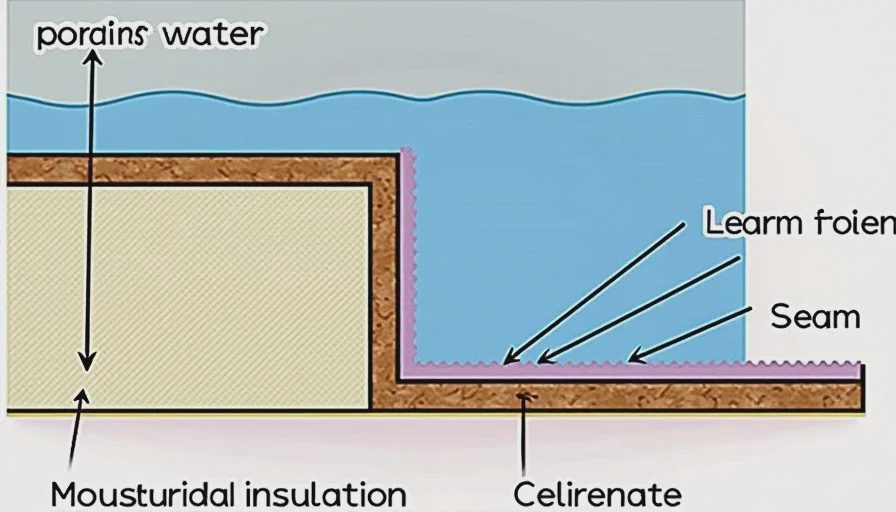
TPO | Fair – TPO is susceptible to seam degradation under prolonged ponding because heat‑welded seams can become brittle and split when submerged repeatedly. | The seam interface is the weak point – water sitting on seams accelerates failure. |
Modified Bitumen | Fair to Good – The asphalt surface can oxidize faster under ponding, but the multi‑ply construction provides redundancy. | Prolonged ponding can accelerate surface checking and blistering, especially if the cap sheet has lost granules. |
Built‑Up Roof (BUR) | Good – Multiple plies and flood coats provide excellent waterproofing; however, prolonged ponding can accelerate surface weathering and blistering. | The heavy gravel surface (if ballasted) protects the asphalt from direct water contact. |
Owner's takeaway: If you have TPO and notice recurring ponding, take it more seriously than if you have EPDM or PVC. The same puddle that would be a minor issue on EPDM could be a seam‑killer on TPO within a couple of years.
The Hidden Damage That Ponding Causes – Beyond the Surface
Even if the membrane itself isn't leaking yet, ponding water does three insidious things:
1. Accelerated Membrane Aging
Standing water traps heat and UV‑degradation by‑products against the membrane surface. The combination of moisture and heat accelerates the breakdown of plasticizers (in TPO and PVC) and asphalt oxidation (in mod‑bit). The ponded area ages 2–3 times faster than the dry areas of the same roof.
2. Insulation Degradation
Water that doesn't drain eventually finds its way through microscopic membrane defects or seam pinholes. Once moisture enters the insulation, it loses R‑value and adds significant weight to the deck. A fully saturated 10,000‑sq‑ft roof can hold 10,000+ pounds of extra water – a serious structural load.
3. Biological Growth and Corrosion
Stagnant water breeds algae, fungi, and moss. These organisms produce acids that attack the membrane and metal flashings. Over time, they also clog drains, creating a vicious cycle of more ponding, more growth, and more degradation.
The 5‑Step Escalation Framework
Use this decision tree every time you observe ponding water on your roof:
Step 1 – Observe and Document
After a rain, note the date, time, and weather.
Photograph each ponding location with a depth reference.
Check if the water drains within 24, 48, or 72 hours.
Step 2 – Check Drainage System
Are the drains clear of debris (leaves, gravel, trash)?
Are the drain strainers intact and not blocked?
Is there a positive slope toward the drains (minimum ¼ inch per foot is typical)?
Step 3 – Evaluate Recurrence
Does the ponding happen after every rain, or only after heavy storms?
If it's every rain, you have a slope issue. If only after heavy rains, you may just need additional drains.
Step 4 – Assess Membrane Condition in Ponded Areas
Look for blistering, cracking, algae growth, or seam lifting in the specific zones where water sits.
Use a moisture meter or thermal scan to check if insulation below is wet.
Step 5 – Decide on Action Level
Findings | Recommended Action |
|---|---|
Ponding < 24 hrs, no membrane damage, drains clear | Monitor – inspect annually and after major storms |
Ponding 24–48 hrs, minor algae, membrane intact | Plan a drain improvement – clean drains more frequently; consider adding a tapered insulation overlay at next re‑roof |
Ponding > 48 hrs, visible membrane blistering/cracking, or wet insulation confirmed | Escalate to repair – add new drains, install tapered insulation, or replace the ponding‑prone membrane section (within 6 months) |
Ponding > 72 hrs or permanent standing water, with significant membrane deterioration and structural concerns | Escalate to replacement – the drainage failure is systemic; repair will not solve the underlying slope problem – plan a full re‑roof with proper positive slope |
When a Simple Fix Solves the Problem
Not every ponding issue requires a major investment. Often, the solution is straightforward:
Clean the drains – this is the cheapest fix (under $200) and solves many ponding problems.
Install drain inserts or "drain buggies" – devices that raise the drain inlet slightly, allowing water to flow without creating a permanent pool.
Add tapered insulation – a tapered overlay can create positive slope to the drains during a re‑cover, eliminating ponding for good (cost: $2–$5 per sq ft added to a re‑roof).
Install scuppers or overflow drains – on parapet roofs, adding secondary drainage can prevent deep ponding (cost: $500–$1,500 per scupper).
Owner's takeaway: Never assume the solution requires a full tear‑off. Many ponding problems can be fixed at modest cost if caught early.
When You Should Escalate Immediately
These are non‑negotiable red flags – if you see any of these, call a professional within one week:
Water depth > 2 inches – this is a structural risk; the added weight could compromise the deck.
Ponding that persists for more than a week – you have a complete drainage failure; roof is likely accumulating debris and biological growth.
Leaks appear directly below ponding areas – water has found a path through the membrane or seams.
Visible rust on the deck below – if you can access the underside, check for rust stains or drip marks.
Sagging deck or ceiling tiles – the structural integrity may be compromised.
The Cost of Waiting – A Real‑World Example
I worked with a retail building owner who had shallow ponding on a 15‑year‑old TPO roof. He monitored it for two years – no leaks, so he assumed it was fine. After a particularly heavy spring, he finally got a ceiling stain. We investigated and found:
Ponding area had seam splits in three locations
Insulation beneath was saturated over 20% of the roof
Energy bills had risen 12% in the previous year (unnoticed)
Repair cost at that point: $18,000 (including insulation replacement and membrane patching)
If he had addressed drainage two years earlier with tapered insulation and a new drain insert: cost would have been approximately $4,000
He delayed – and paid 4 times as much, plus the energy waste. The roof is still limited to 5 more years instead of the 8–10 he could have gotten.
A patch is not a plan. And ignoring drainage is not saving money.
Get a Professional Drainage Assessment
Ponding water is one of the most common – and most manageable – commercial roof problems. But you need a trained eye to differentiate between "minor nuisance" and "hidden accelerator."
SelectHomeQuote can connect you with local commercial roofing professionals who specialize in drainage evaluation and repair. They'll:
Inspect your roof's slope, drains, and membrane condition
Provide a clear report on the severity of your ponding issues
Quote you on drain cleaning, insulation correction, or full slope correction – depending on what's needed
No obligation. No sales pressure. Just straightforward, local expertise.
Start with a free quote comparison:
➡ Enter your ZIP code on SelectHomeQuote – and get the clarity you need to decide whether to monitor, repair, or escalate your ponding problem.
Keep Reading

Drain Cleanout Problems on Commercial Flat Roofs: What Owners Should Know
Drain cleanout guidance for commercial flat roofs: learn what blockages mean, wh...
7 Signs a Commercial Flat Roof Leak Is Bigger Than the Ceiling Stain
Why Flat Roof Leaks Around HVAC Curbs and Penetrations Keep Returning
Owner Letters
0 lettersNo letters yet — be the first to write one.